

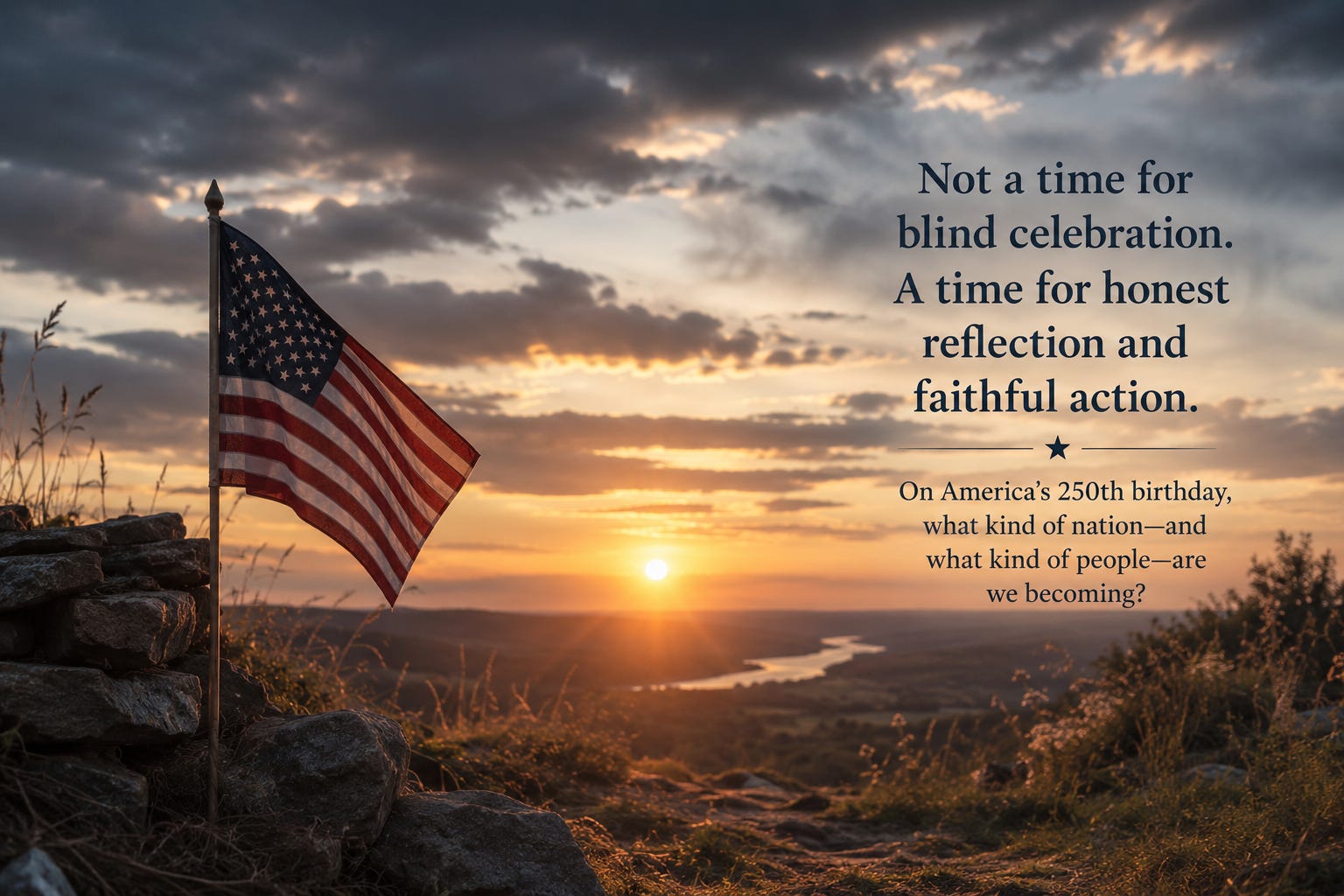
Tomorrow, the United States celebrates the 250th anniversary of its independence. Two hundred and fifty years is no small thing. By any measure, it is a remarkable milestone in the life of a nation, especially one born from a bold and imperfect experiment in freedom.
And yet, as I sit here listening to the pounding upstairs from the Loving Homestead renovations the day before this historic July 4th, I find myself strangely unable to simply join the celebration.
Not because I don’t love this country but because I do so very much. I’m so grateful that the forces of life allowed me to be born in Weymouth, MA a little over seventy-seven years ago. I do not take that bit of kismet for granted.
That distinction matters to me. This is not intended as a political article, even though politics is the language many of us have been trained to use when we talk about the state of our nation. Politics matters, of course. Policies matter. Elections matter. Leadership matters. But beneath the politics, there is something deeper:
the stories we live inside, the assumptions we rarely question, the values we embody, and the future we are either consciously creating or unconsciously drifting toward.
Lately, as part of my morning One Cause vow, I’ve begun asking a simple question:
What is the web of life asking from me today?
This morning, that question did not lead me to an answer so much as a deeper inquiry. What does it mean to honor Independence Day when so much in our national life (and consequently our world) feels fractured, fearful, and off course? What does it mean to love a country without pretending it is well? What does it mean to grieve the direction we seem to be heading while still refusing to surrender the possibility of something better?
I don’t feel at home in either of the easy camps. I cannot celebrate blindly, waving a flag as though all is well. But neither do I want to become one more voice shouting into the great national storm, convinced that outrage alone is a contribution. I know people who seem to think patriotism means defending everything America does. I know others who seem to think honesty requires condemning everything America has been. Neither feels whole to me.
A nation, like a family, can be deeply loved and deeply troubled at the same time.
Two hundred and fifty years ago, courageous and complicated people declared independence from a distant king. That declaration was visionary and incomplete, inspiring and flawed, liberating for some while excluding many others. It’s been a work-in-progress ever since.
The American story has always carried both promise and contradiction. Perhaps every human story does. What matters now, at least to me, is not whether we can polish the past until it shines or condemn it until nothing remains. What matters is whether we can tell the truth about where we are and still choose who we are becoming. Let me rephrase that as a question:
Can we tell the truth about where we are and still choose who we are becoming?
And that brings me to the possibility that maybe this particular Independence Day is inviting us into a new kind of declaration—not independence from another nation, but independence from the assumptions that have brought us to this moment.
For starters, let me suggest a few.
How about independence from the belief that we are separate from one another and from the living Earth.
Independence from the story that more is always better.
Independence from the illusion that Earth’s resources are endless and ours to consume without consequence.
Independence from the hope that technology alone will save us from the deeper transformation we are avoiding.
In the language of One Cause, maybe this is a moment to begin freeing ourselves from the Four Great Untruths and recommitting ourselves to the Four Great Truths:
Interconnectedness,
Sufficiency,
Reciprocity, and
Stewardship.
Not as political slogans. Not as ideology. Not as something to argue about online. But as ways of being we practice in our families, our neighborhoods, our communities, and our relationship with the living world.
When I look at Logan and Piper, this all becomes much less abstract. They don’t wake up asking whether the world is red or blue. They notice worms, flowers, birds, puddles, berries, bugs, and whether the adults around them feel safe and loving. They are learning, every day, what kind of world this is by watching how we live inside it. And I find myself wondering: What version of “normal” are we handing them?
Perhaps a new patriotism is being asked of us now. Not the patriotism of certainty or superiority, but the patriotism of stewardship. The kind that loves a country enough to help it mature. The kind that tells the truth without bitterness. The kind that plants trees, repairs relationships, protects children, tends soil, welcomes neighbors, and asks what freedom is actually for.
Because freedom is not only freedom from.
It is freedom for.
Freedom for compassion. Freedom for responsibility. Freedom for service. Freedom for the long, humble work of becoming better humans, parents, and ancestors. Freedom to participate in the healing of a world that is not separate from us, and never has been.
So tomorrow, I may still watch fireworks though probably just listen to them from the distance as I try to calm my two canine companions. I may still feel gratitude for the many blessings this country has made possible in my own life. And I may also feel sadness, concern, and grief for how far we still have to go.
Both can be true.
Maybe that is what maturity asks of us—to hold love and grief in the same heart without collapsing into denial or despair.
This Independence Day, I’m not sure I can celebrate in the old way. But I can recommit. I can recommit to living as though the web of life is real, sacred, and asking something of me. I can recommit to my family, my community, and this small patch of Earth we call the Loving Homestead. I can recommit to the future Logan and Piper deserve.
And perhaps that is celebration enough.
This weekend, maybe the question is not simply, “What are we free from?” Maybe the deeper question is,
“What are we free to become?”


